Why Your Corrective Actions (CAPA) Fail (and How to Truly Fix Them)
Continuous Improvement on the shop floor often hits a practical limit: everyone recognizes its value, but few manage to turn it into a process that generates real profit.
Most of the time, Corrective and Preventive Actions (CAPA) end up being a heavy bureaucratic burden just to pass an ISO 9001 audit. You open the form, describe the anomaly, sign it, and file it away.
However, if six months later the same error repeats on the same production line, it means that CAPA has failed. It didn't correct anything; it only generated paperwork and wasted time.
The Problem: The Gap Between Office and Shop Floor
Corrective actions fail when they remain isolated from daily work. If the process is managed on Excel sheets or paper binders, it becomes a static activity that doesn't communicate with production.
The issues we encounter when speaking with Quality Managers are almost always threefold:
- Partial Data: The anomaly is reported hours after it occurred, losing crucial details.
- Lack of Accountability: Actions are assigned, but without alerts and monitoring, deadlines slip away in the chaos of daily emergencies.
- Lack of Verification: The file is closed as soon as the action is implemented, without ever checking back to see if the problem was actually eliminated.
Turning the Error into a Digital Asset
At Moko, we chose to approach continuous improvement not as a static software module, but as an anomaly management workflow.
Digitizing CAPA doesn't mean "typing on a computer"; it means creating a system where data circulates and generates alerts. Here is how operations change:
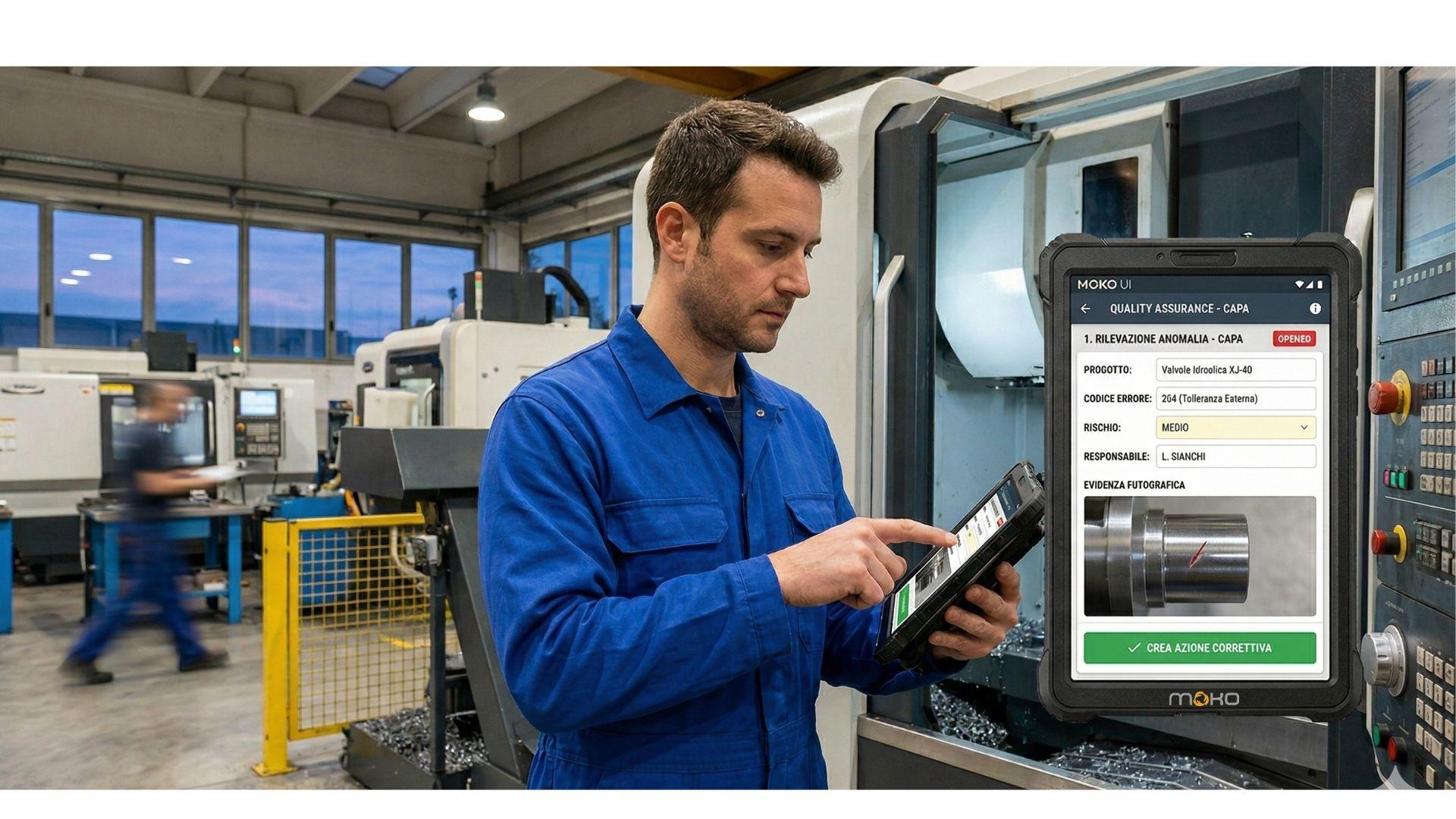
- Reporting at the Machine: The operator opens the report in real-time from a tablet. Photos and voice comments eliminate any doubt about the nature of the problem.
- Dynamic Workflows: The corrective action becomes a specific task. The system assigns responsibilities and monitors progress, notifying of delays before they become critical.
- Result-Based Closure: A CAPA doesn't close because "we did something," but because the data proves that the scrap rate has actually decreased.
Why Moko Writes About CAPA and Improvement
At Moko, we don't consider ourselves just software vendors. Many companies call us because they already have an expensive ERP or management system that stops at the office door. When it comes to the heart of production, between machines and operators, that software becomes too rigid, complicated, or simply useless.
Our work starts where others stop.
We write about these topics because every day we see the frustration of Quality Managers and Production Directors who know exactly where the problems are but lack the agile tools to solve them. We develop custom solutions because we believe technology should adapt to your real processes, not the other way around.
Digitizing a CAPA with Moko doesn't mean adding another task for the operator; it means giving them a tool that simplifies their life and protects the company's margins.
Beyond Compliance: Real Efficiency
The goal of a modern system isn't to have orderly binders for the inspector, but the mathematical certainty that the company is learning from its mistakes.
When preventive actions stop being written out of duty and start being guided by data, the savings are immediate: fewer scraps, fewer reworks, and technical know-how that stays within the company—protected even in the event of staff turnover.
Continuous improvement isn't an abstract concept: it's a process that must keep pace with the shop floor.

-thumb_jpg.jpg)
-thumb_jpg.jpg)
-thumb_jpg.jpg)