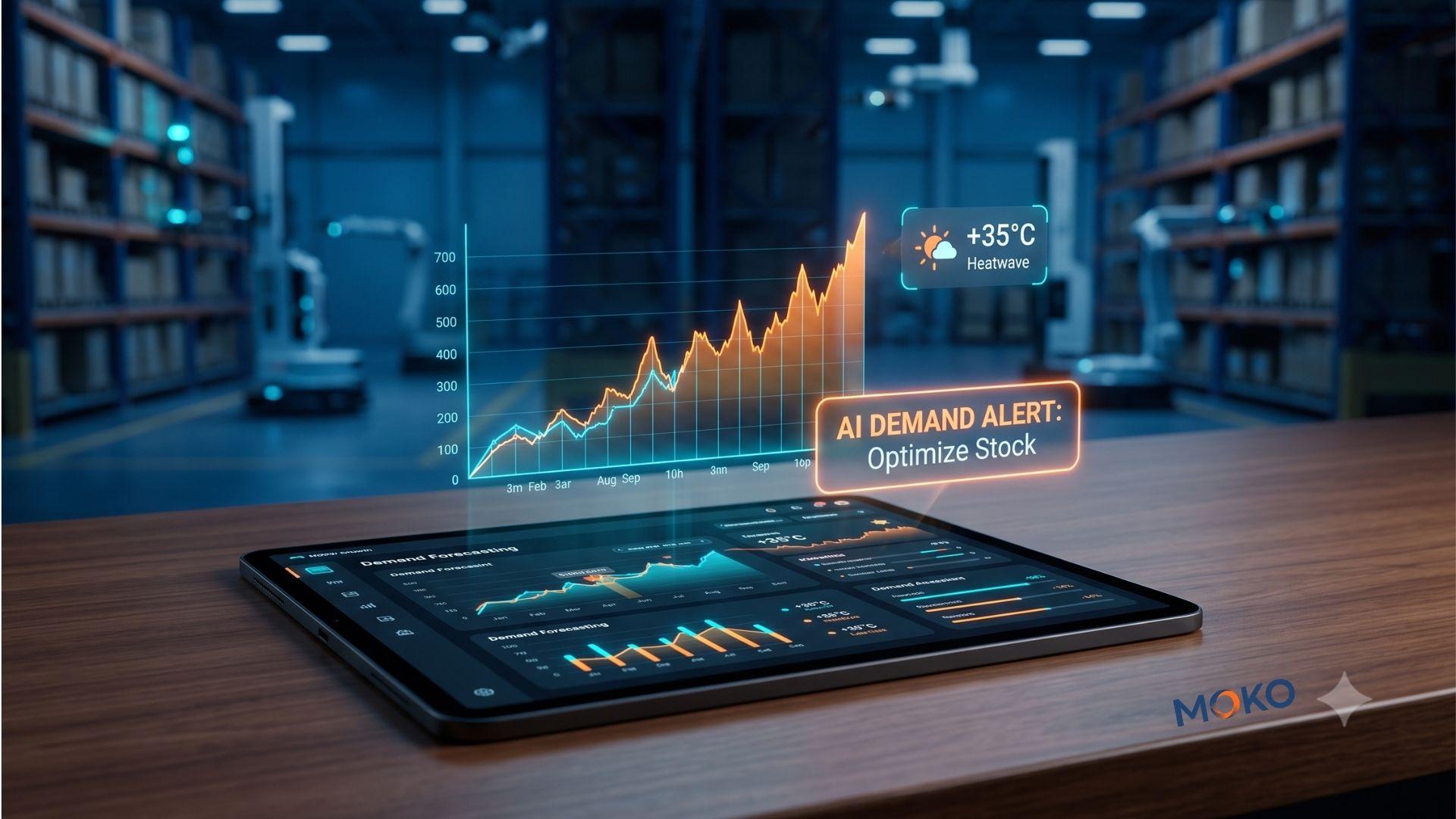
Demand Forecasting and AI: when weather and tourist flows drive industrial production
Anticipating market fluctuations requires much more than simple sales history. MOKO Growth integrates predictive models and real-time external variables to align the Supply Chain with actual market demand, optimizing stock and margins.
Governing industrial production and planning procurement on a simple average of past sales exposes companies to two major operational inefficiencies: tying up capital in excess stock on one hand, and stockouts resulting in lost revenue on the other.
For high-volatility sectors such as Food & Beverage and Retail, consumer demand varies dynamically. A sudden heatwave, a major local event, or a heavy tourist influx radically alters consumption within a few hours.
To enable Production and Supply Chain to stay ahead of the market, an advanced analytical approach is necessary: cross-referencing transactional historical ERP data with real-time exogenous variables.
The Evolutionary Leap: From Statistical Analysis to Exogenous Artificial Intelligence
Traditional ERP systems (such as SAP or Dynamics) accurately record what happened yesterday. To project the company into tomorrow, Moko has engineered the AI Sales Forecasting (Previsione Vendite AI) module of MOKO Growth, an advanced Demand Forecasting solution within the Ready-to-Use line.
The technological core of the module relies on a Data Ingestion (ETL) pipeline that automatizes the loading of daily historical sales from the ERP system and feeds them into advanced predictive models (ARIMA, Prophet, LSTM Neural Networks). The real innovation lies in the API connection to third-party providers, which enriches the calculation with:
- Accurate weather data with 15-day forecasts.
- Tourist flows and local events with a high territorial impact.
- Mobility indicators (Telco data) and monitoring of active marketing campaigns.
The system operates in Continuous Learning: the algorithm constantly compares its forecasts with actual sales, self-adjusting algorithmic weights (Fine-tuning) to autonomously improve accuracy over time.
Control at the Center: Scenario Simulators and Strategic Recommendations
The backend's computational complexity translates into an immediately intuitive interface for Supply Chain and Operations managers:
- "What-if" Simulators: Managers can vary operational parameters in real time to test market scenarios. It is possible to ask the interface: "What happens to sales volumes if the temperature rises to 35°C and we activate the summer promotion?" and observe the demand curve adapt in just a few moments.
- Granular Dashboard: The system displays the forecasted volume in kilograms or individual units, alongside the percentage differential compared to the seasonal baseline, featuring filters that drill down from the macro-regional level to a single product code or point of sale.
- Textual Business Recommendations: The AI generates direct operational advice to guide immediate decisions, providing clear directions such as: "Demand Alert: increase production on seasonal batches."
Concrete Competitive Advantages and Impact on EBITDA
Implementing MOKO Growth generates a tangible return on investment across the entire value chain:
- "Just-in-Time" Production: Reduction of capital tied up in the warehouse thanks to flow planning aligned with real market demand.
- Gross Margin Maximization: In the Food & Beverage sector, forecasting accuracy drastically reduces unsold goods and the disposal of expired products (Zero Waste).
- Proactive Logistics: The ability to anticipate demand peaks by repositioning goods in peripheral warehouses before the event or weather wave occurs.
By combining tailor-made quality in developing customized Machine Learning models with the off-the-shelf deployment speed of seamless API integration and ETL pipelines integrated with SAP or Dynamics, MOKO Growth brings Ready-to-Use innovation to the operational heart of the company.

-thumb_jpg.jpg)
-thumb_jpg.jpg)
-thumb_jpg.jpg)