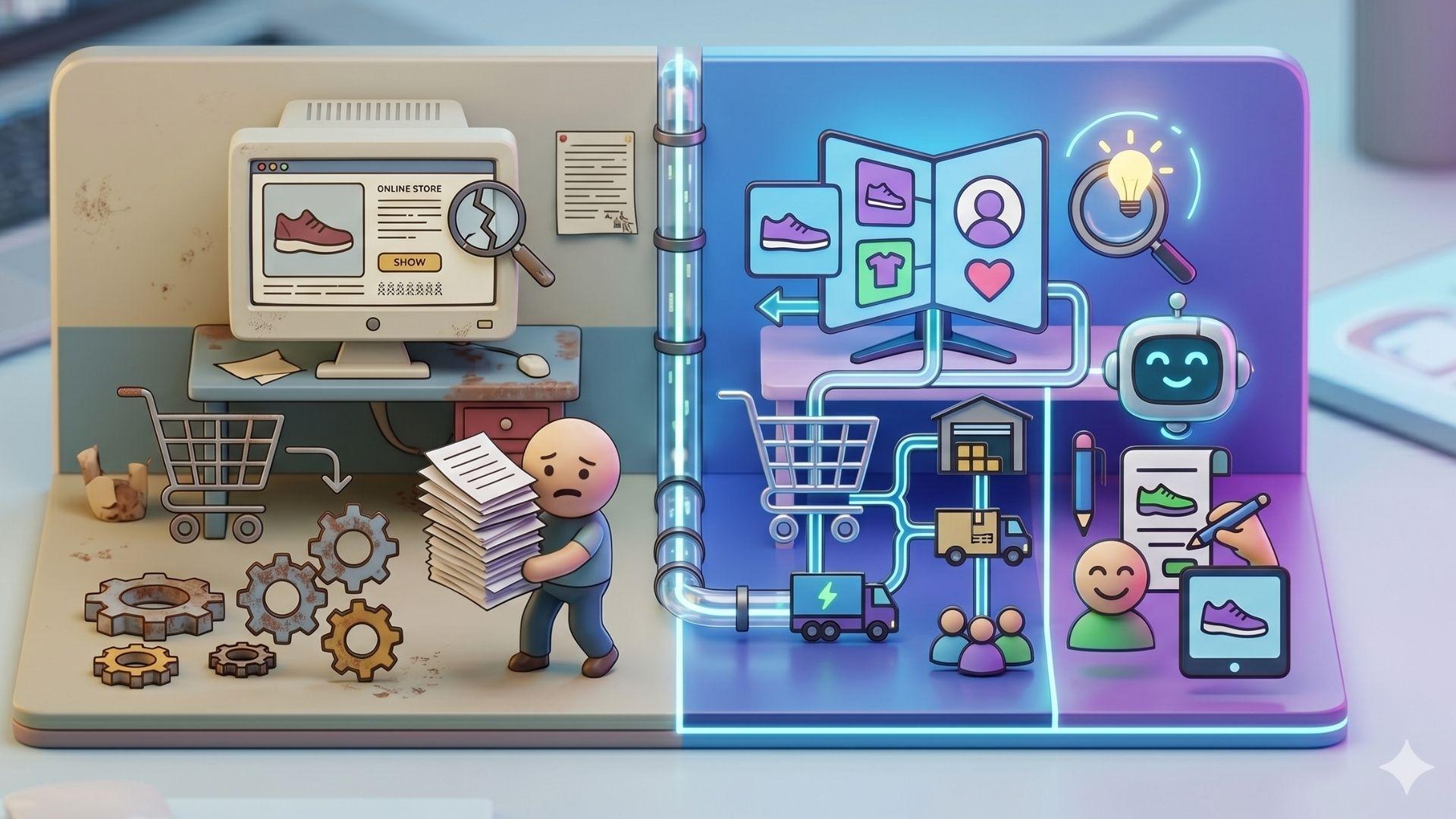
E-commerce Evolution: How AI Went from a 2023 Trend to an Invisible Engine
There was a time when opening an e-commerce store was a purely technical operation. You just took the company catalog, uploaded product photos, added a price, a payment system, and that was it. Whoever hit the web first, sold.
Today, that pioneering market is ancient history. The sector is saturated, users are hyper-demanding, and "copy-paste" sites based on standard templates are seeing drastic drops in conversions.
To understand where we are headed, we need to take a step back and look at what happened over the last three years. 2023 was year zero: the explosion of generative AI caught everyone off guard. Many companies reacted on impulse, flooding their sites with basic chatbots that wasted customers' time or using automated texts that all sounded identical.
Today the fog has cleared. AI has stopped being a surface-level trend and has become the invisible engine of modern e-commerce. Here is how the way we sell online has radically changed.
The Metamorphosis: from Static Cart to Predictive E-commerce
If the website used to be a passive entity waiting for user action, today we are witnessing a revolution driven by three core pillars:
- From Text Search to Real Understanding: until recently, if a user mistyped a single letter in the site's search bar, the result was the frustrating "No products found" screen. Today, AI understands context and intent. If a user searches for "dress for a wedding in June", the system doesn't just look for the word "wedding" in the product sheets; it suggests elegant, lightweight dresses. The experience becomes human, much like interacting with a real-life shop assistant.
- Extreme UX Personalization: showing the exact same homepage to every single user is a strategic mistake. Today, historical browsing and purchasing data allow the site to adapt in real time. A returning customer will see products tailored to their interests, dedicated price lists, or bespoke promotions, while a new user will be guided toward discovering best-sellers.
- Back-Office Automation: the most massive shift happens where it can't be seen on screen. Manually creating hundreds of product descriptions, translating them for foreign markets, and optimizing them for search engines used to take weeks of work. Today, integrated systems generate accurate drafts in seconds, leaving the internal team with only the task of supervising and adding the final touch.
Behind the Scenes: integration is everything
All this intelligence, however, turns off if it doesn't communicate with the heart of the company. A modern e-commerce cannot live in isolation. It must dialogue in real time with the warehouse, update availability to avoid selling out-of-stock products, connect to invoicing systems, and track shipments automatically.
If the software infrastructure isn't flexible and integrated, AI becomes just an unnecessary cost, and logistics risks collapsing under the weight of slow, manual data entry.
The Real Impact: What Changes for Business Managers
The bottom line is that AI doesn't replace a good software infrastructure; it speeds it up. Selling online today is no longer a race to the steepest discount, but a race to offer the best convenience and relevance.
Competitive advantages are measured on two fronts:
- User Side: Fewer steps, zero search errors, seamless experience.
- Company Side: Fewer repetitive tasks for the team (such as manually writing hundreds of descriptions or translations) and data flowing directly into the CRM and warehouse without bottlenecks.
Integrating these technologies doesn’t mean turning the company upside down, but making systems talk to each other intelligently. Technology must adapt to your real processes, not force you to adapt to standard software.
Is your e-commerce optimized for current workflows, or does it need a technical evolution? Let’s assess the situation: together, we can analyze your platform.
-thumb_jpg.jpg)
-thumb_jpg.jpg)
-thumb_jpg.jpg)