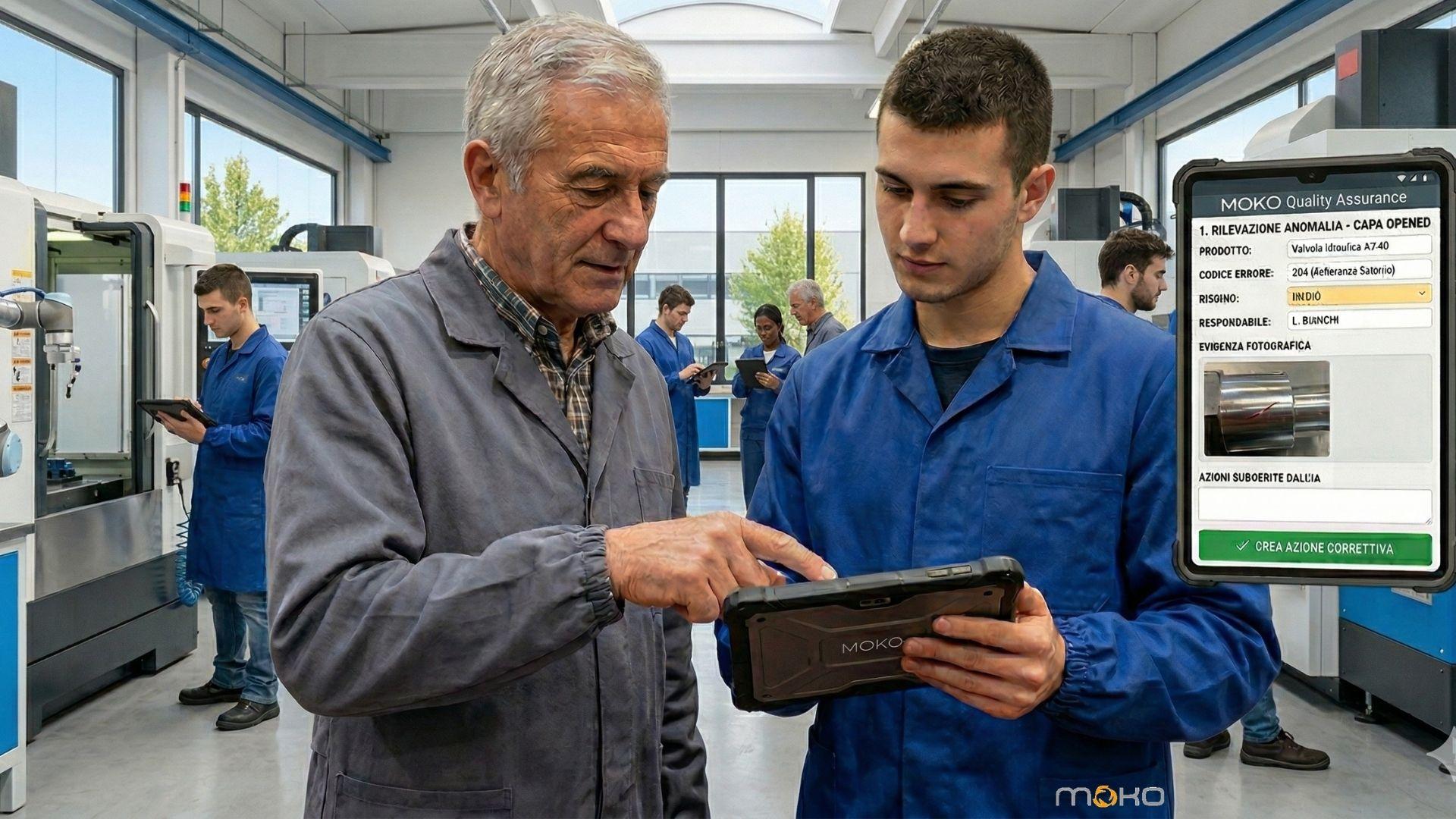
Know-How Doesn't Retire: Protecting the Technical Heritage of the Shop Floor
In many Italian manufacturing companies, the most valuable database doesn't reside on a server, but in the collective memory of a few key individuals. These are the shop floor veterans: those who can "feel" if a machine is malfunctioning just by its sound, who know every secret of the materials, and who can resolve an anomaly in half the time it takes anyone else.
However, the industrial sector is facing an unprecedented demographic challenge. When these figures leave the company for retirement, the risk isn't just operational - it’s strategic: a massive hemorrhage of know-how that can take years to recover.
The limits of the "Apprenticeship" model
Traditional knowledge transfer, based on constant side-by-side mentoring, is now clashing with increasingly tight production schedules and growing technological complexity. There is simply no longer the physical time to transfer decades of experience through observation alone.
Without adequate digital tools, "tricks of the trade" remain individual intuitions and never become corporate assets.
Digitalizing Experience (without the bureaucracy)
The goal of intelligent digital transformation, such as that offered by the Moko Suites, isn't to replace humans, but to "download" their knowledge into a system that makes it eternal and accessible.
But how do you transform experience into a digital asset?
- From Correction to Procedure: Every time an operator resolves an anomaly or opens a CAPA (Corrective Action), the system tracks not just the error, but the logic behind the solution.
- Active Historical Memory: thanks to Intelligence modules, the software analyzes historical data. If a junior technician encounters an unusual problem, the system can suggest the exact solution successfully implemented years earlier by their predecessor.
- Support for Juniors, value for Seniors: Digitalizing knowledge allows veterans to "teach" in a scalable way, reducing time wasted on repetitive explanations and allowing new hires to become autonomous and productive much faster.
Safeguarding Quality
Protecting know-how means safeguarding the company's competitive advantage. A workshop that learns from its mistakes and its successes is a company that never has to start from scratch every time staff changes.
Handing over the baton shouldn't be a moment of crisis, but an opportunity to transform the excellence of a few into the production culture of many.
-thumb_jpg.jpg)
-thumb_jpg.jpg)
-thumb_jpg.jpg)